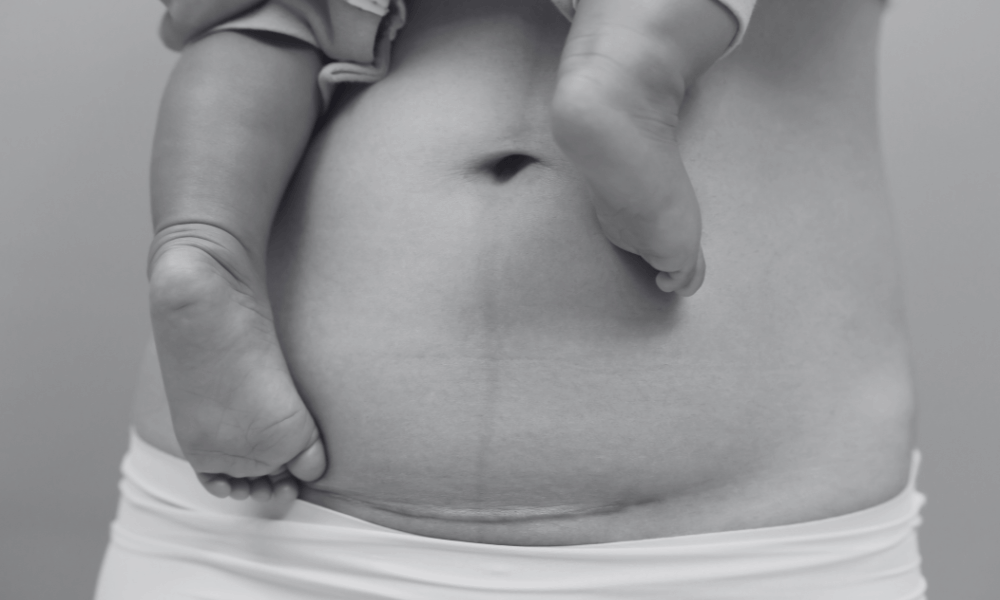
The caesarean scar is one of the most common surgical scars in the country, and one of the least discussed. In 2023, forty-one per cent of women who gave birth in Australia did so by caesarean section [1]. In the weeks afterwards, attention understandably goes to the baby and to recovery in general. The scar often gets very little thought until it starts causing problems.
Most caesarean scars heal well. Some do not, and become raised, tight, itchy, numb, tethered or painful. Many of these concerns can be assessed and managed, including years afterwards.
How long does a C-section scar take to heal?
The wound itself usually closes within one to two weeks. That is not the same as the scar having matured, and the difference between the two causes a great deal of unnecessary worry.
Healing happens in overlapping stages.
- Inflammation dominates the first few days, while damaged tissue is cleared and healing begins.
- Proliferation follows. Fibroblasts, the cells that make collagen, move into the wound and lay down new collagen. This early collagen is disorganised and provides bulk rather than strength.
- Remodelling then continues for a year or more, as that immature collagen is gradually replaced with a stronger, better organised form.
That last stage is why a scar keeps changing long after it looks closed. Redness and firmness at three months usually reflect a scar that is still actively remodelling, rather than a complication. A scar generally reaches only around seventy to eighty per cent of the strength of the original skin, and takes twelve to twenty-four months to get there.
Several things influence the eventual outcome:
- genetics and a family history of problematic scarring
- skin type
- whether the wound became infected or was slow to heal
- the tension across the lower abdomen
- the hormonal and inflammatory changes that follow delivery.
Why the lower abdomen is a demanding place for a scar
Where a scar sits on the body influences how it behaves, and the area above the pubic bone is not a forgiving location.
Research measuring how far skin stretches and contracts at different sites has identified this area as among the most mobile on the body [2]. That matters because fibroblasts respond to mechanical load. Under sustained tension they can produce more collagen, and they are more likely to persist in a contractile form rather than settling as the wound matures.
In practical terms, a caesarean scar is being loaded every time you stand, bend, lift or cough — throughout the whole period in which the scar is forming.
Tension is not always the dominant issue after a caesarean, since the tissues are often lax following pregnancy. More commonly the scar becomes tethered to the structures beneath it, which is what produces the shelf-like appearance many women describe.
Why does my C-section scar itch?
Itch after a caesarean is very common, and usually has several causes at once.
Nerves divided by the incision grow back into the healing tissue, and that regrowth can produce abnormal signals felt as itch, tingling or a crawling sensation. Ongoing low-grade inflammation in the remodelling scar contributes as well. Scar tissue also contains fewer working oil and sweat glands than normal skin, so it is drier and more easily irritated. And this scar sits exactly where waistbands and clothing rub.
Most itch settles as the scar matures and the nerves finish regenerating. Itch that persists well beyond that, or that is severe enough to disturb sleep, is worth having assessed rather than tolerating. Persistent itch after surgery is a recognised clinical problem with recognised treatments. Itch also often improves considerably during healing with simple measures.
Why is my scar red, painful or numb?
Redness reflects the extra blood vessels in a scar that is still remodelling. New vessels form during healing and gradually reduce over the following months, which is why redness fades slowly.
Numbness above the scar is very common and can last a long time. The incision divides small sensory nerves supplying the skin below the navel, and the result is often described as a band of reduced feeling across the lower abdomen. Some sensation usually returns as the nerves recover, though not always completely.
Pain and altered sensation relate largely to that same nerve recovery. It can feel sharp, burning or electric — qualities typical of nerve-related pain. This is more common than generally recognised. Pooled data from multiple studies indicate that around fifteen per cent of women still have wound-related pain at three to six months, and around eleven per cent at twelve months or beyond [3]. Most of it is mild, but it is neither unusual nor something to be dismissed.
Tethering deserves particular mention. Where the scar sticks to the deeper layers, the skin can no longer glide over the tissue beneath. This produces a pulling sensation, sometimes a visible dip or shelf above the scar, discomfort on movement, and a feeling of tightness that seems out of proportion to how the scar looks.
When can treatment begin?
Silicone can generally start once the wound has fully closed, with no crusting, drainage or open areas. Silicone gel, tape or sheeting works by keeping the outer layer of skin hydrated, which appears to influence how much collagen is laid down. Consistent daily use over months is generally more useful than using it now and then.
Massage and scar mobilisation may be introduced once the incision has healed adequately, and are particularly useful where tethering is developing. Working on the glide between the scar and the tissue beneath is different from simply rubbing the surface. Technique and timing both matter, which is why guidance is preferable to improvising.
Laser and other energy-based treatments are judged on how the scar is behaving rather than against a fixed date, and they are not necessarily a later step. Where a scar is showing early thickening, persistent redness or tethering, treatment may be introduced relatively soon after the wound has closed. Current understanding favours intervening while the scar is still biologically active, because the tissue remains more responsive during that period. Where a scar is settling well, waiting and reviewing is equally reasonable.
Is treatment safe while breastfeeding?
This is a common and reasonable question. Suitability depends on the specific treatment being considered, and it should be discussed at consultation rather than assumed either way. Topical and physical approaches such as silicone, massage and pressure raise different considerations from treatments involving medication.
How many sessions are needed?
There is no standard number. It is best estimated after individual assessment.
It depends on what the scar is doing, how long it has been there, its thickness and pliability, and what is being treated. A scar treated mainly for itch and tightness follows a different course from one treated for bulk and colour.
Treatment is generally staged over months, with deliberate gaps to let the tissue respond between sessions, and with review rather than a fixed course booked in advance.
Can a C-section scar be treated years later?
Yes. Mature scar tissue can remain biologically active, and treatment may still be considered years afterwards.
- Where the concern is tethering, restriction or a visible overhang, release or surgical revision may be appropriate.
- Where the concern is thickness, texture or colour, laser-based treatment can help.
- Where symptoms are the issue — itch, pain, sensitivity — these can be addressed regardless of how long they have been present.
Women often present after their last pregnancy, having lived with a symptomatic scar for years on the assumption that nothing could be done. An assessment can help clarify what options may still be appropriate.
The overhang question
A visible shelf or fold sitting above the scar line is a common concern, and it has more than one cause.
Sometimes it is tethering. The scar is stuck to the deeper layers and pulls the skin inward along the incision line, so the tissue above appears to sit over it. Releasing that can improve the contour considerably.
Sometimes it reflects the distribution of fatty tissue above the scar rather than the scar itself. In that case scar treatment alone will not change it, and the honest answer is to say so.
Often it is both. Distinguishing between them is what assessment is for, and it matters because the two respond to entirely different things.
Does every C-section scar need treatment?
No. Most heal well and cause no difficulty, and there is no reason to treat a scar that is not bothering you.
Assessment may be worth considering if the scar is:
- raised, thickened or widening
- persistently itchy or painful
- tethered or pulling
- numb in a way that troubles you
- repeatedly irritated by clothing.
Concerns about how a scar looks or feels can also be discussed as part of an assessment. In general, a scar is easier to influence while it is still changing than once it has fully matured, so earlier review is usually preferable.
Scarless – The Clinic assesses and treats caesarean and other surgical scars in Sydney, including established scars years after delivery. Get in touch to arrange a consultation if appropriate.
All procedures carry risks and potential complications. A comprehensive consultation and clinical assessment are required to determine suitability. Individual results may vary.
References
- Australian Institute of Health and Welfare. Australia’s mothers and babies: method of birth. Canberra: AIHW; 2026.
- Ogawa R, Okai K, Tokumura F, et al. The relationship between skin stretching/contraction and pathologic scarring: the important role of mechanical forces in keloid generation. Wound Repair Regen. 2012;20(2):149–157.
- Weibel S, Neubert K, Jelting Y, et al. Incidence and severity of chronic pain after caesarean section: a systematic review with meta-analysis. Eur J Anaesthesiol. 2016;33(11):853–865.